
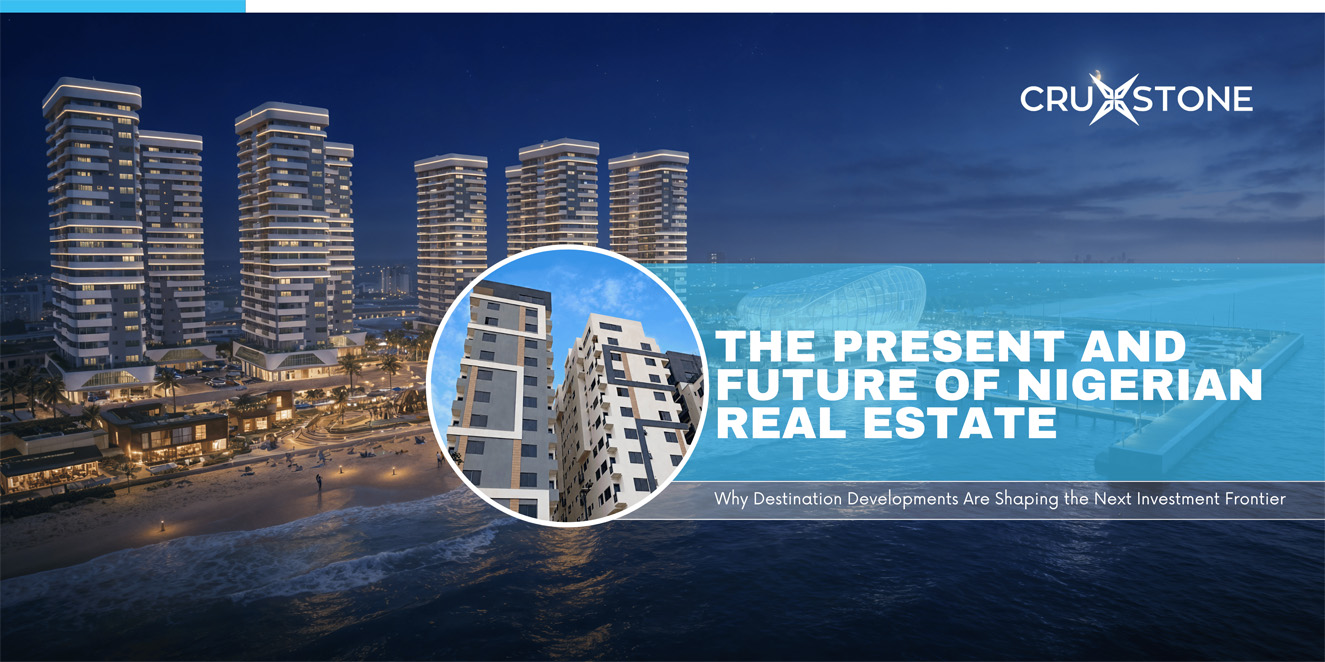
Why Destination Developments Are Shaping the Next Investment Frontier
Nigeria’s real estate market is entering one of its most transformative periods in recent history. Following several years of economic uncertainty, the sector is beginning to benefit from improving macroeconomic fundamentals, policy reforms, moderating inflation, renewed investor confidence, and sustained urbanisation.
While challenges such as affordability and housing supply remain, the market is showing clear signs of resilience. Across residential, commercial, industrial, and retail real estate, new opportunities are emerging for investors who understand where the market is headed rather than where it has been.
For discerning investors, the question is no longer whether to invest in Nigerian real estate, but where the next generation of value will be created.
A Market Finding Its Footing
According to Knight Frank’s 2026 Africa Horizons report, Nigeria’s property market is gradually stabilising as economic reforms begin to restore confidence.
Inflation is easing, exchange rate volatility is becoming more predictable, and businesses are once again making long-term investment decisions. These improvements are translating into measurable activity across the property sector, particularly in premium developments and strategically located growth corridors.
Rather than experiencing rapid speculative growth, the market is entering a healthier phase characterised by more disciplined investment, stronger fundamentals, and greater transparency.
Lagos Continues to Lead the Market
Lagos remains the engine room of Nigeria’s real estate sector.
As Africa’s largest commercial city, its growing population, expanding middle class, and limited supply of premium housing continue to support long-term demand for quality developments.
According to Knight Frank’s Lagos Market Update H2 2025, prime office rents in Lagos average approximately US$55 per square metre per month, positioning the city among Africa’s most expensive prime office markets.
Although landlords are increasingly offering flexible lease structures to improve occupancy, demand remains concentrated in high-quality, well-located buildings.
This shift highlights an important trend across the property market: investors and occupiers are placing greater emphasis on quality, convenience, and long-term value than ever before.
Residential Demand Remains Strong Despite Affordability Challenges
Perhaps the clearest indicator of Nigeria’s real estate potential is the continued imbalance between housing demand and supply.
Despite moderating inflation, residential rents continue to rise across key urban centres, reflecting the country’s persistent housing deficit and sustained population growth.
Affordability remains the market’s greatest challenge. As household budgets tighten, many residents are moving towards more affordable neighbourhoods or choosing smaller apartment formats such as studios and one-bedroom units.
At the premium end of the market, however, demand remains resilient. Knight Frank estimates that prime residential properties command average monthly rents of approximately US$3,000, demonstrating continued appetite for high-quality developments in prime locations.
For long-term investors, these dynamics reinforce a simple reality: quality residential assets in well-planned communities continue to attract strong demand.
Industrial and Retail Markets Are Evolving
Beyond residential property, Nigeria’s industrial and retail sectors are also undergoing significant transformation.
Demand for Grade A logistics facilities is growing around Special Economic Zones such as Alaro City and the Lagos Free Zone, where improved infrastructure and integrated customs processes are attracting manufacturers and logistics operators.
Meanwhile, retail is becoming increasingly neighbourhood-focused. Rather than relying solely on large shopping centres, consumers are gravitating towards convenience-led and hyper-local retail formats that serve residential communities more efficiently.
These trends reflect broader changes in consumer behaviour and urban development, reinforcing the importance of mixed-use communities where people can live, work, shop, and relax within a single destination.
The Rise of Destination Developments
Perhaps the most significant evolution in Nigerian real estate is the shift from standalone buildings to destination developments.
Modern investors are no longer purchasing property based solely on square metres or location. They are investing in lifestyle, experience, and long-term value.
Destination developments combine residential living with hospitality, leisure, wellness, retail, and community infrastructure to create environments where people genuinely want to live, work, and spend time.
This global approach to placemaking is becoming increasingly relevant in Nigeria as buyers seek more than just a home – they seek a complete lifestyle.
Projects that integrate waterfront living, wellness amenities, hospitality experiences, recreational facilities, and commercial offerings are increasingly positioned to outperform conventional developments because they create enduring demand and enhance long-term desirability.
Why Nautica Rise Represents This New Direction
This evolution is reflected in developments such as Nautica Rise, where the vision extends beyond property ownership to creating a destination.
Rather than delivering a standalone residential project, destination developments seek to create thriving communities supported by leisure, hospitality, and lifestyle infrastructure.
Private beachfront access, recreational facilities, wellness amenities, hospitality experiences, and thoughtfully planned communal spaces contribute to an ecosystem that appeals not only to homeowners but also to investors seeking long-term capital appreciation and income-generating opportunities.
Around the world, destinations that successfully combine lifestyle with investment potential have consistently demonstrated strong market resilience because they create value beyond the physical asset itself.
Nigeria’s growing affluent population, expanding diaspora investment, and increasing demand for premium experiences suggest that destination-led developments are likely to play an increasingly important role in the country’s real estate future.
Lessons from Lagos’ Luxury Market
The remarkable appreciation of luxury residential property across Lagos over the past decade illustrates the wealth creation potential of prime real estate.
Properties in established premium locations such as Lekki, Ikoyi, and Victoria Island have experienced substantial value growth as infrastructure has improved, demand has increased, and available land has become increasingly scarce. Today, high-end five-bedroom homes in some of these neighbourhoods can command prices exceeding ₦1 billion, reflecting how premium real estate has evolved into a significant long-term wealth asset.
While past performance does not guarantee future returns, the trend demonstrates an important principle: investors who identify high-quality developments in strategic growth locations often position themselves to benefit as those locations mature.
As new lifestyle destinations emerge along Nigeria’s coastline and within expanding urban corridors, similar value creation opportunities may continue to develop for investors with a long-term perspective.
Looking Ahead
Nigeria’s real estate story is still being written.
Urbanisation will continue to increase demand for housing. Infrastructure investment will open new development corridors. Government reforms will improve transparency and strengthen investor confidence. Technology will make property transactions more accessible, particularly for diaspora investors.
At the same time, the market is becoming more sophisticated. Buyers are increasingly evaluating developments based on governance, sustainability, amenities, construction quality, and long-term liveability rather than price alone.
The future belongs to developments that create communities rather than simply constructing buildings.
For investors, this represents an opportunity to participate in a market that continues to evolve while benefiting from the long-term fundamentals that have always made real estate one of the world’s most resilient asset classes.
Final Thoughts
Every generation witnesses a shift that redefines its property market. In Nigeria, that shift is already underway.
The conversation is moving beyond land ownership and standalone developments towards integrated communities, destination living, and experience-driven investments. As policy reforms improve the investment environment and infrastructure expands across key growth corridors, investors who recognise these structural changes will be better positioned to identify tomorrow’s opportunities.
At Cruxstone, we believe the future of Nigerian real estate lies in creating places that deliver lasting value, not only through quality construction but through thoughtful planning, lifestyle experiences, and sustainable communities that stand the test of time.
Stay Ahead of the Market
The Nigerian property market is evolving rapidly, and informed investors consistently make better decisions.
Subscribe to the Cruxstone Newsletter for exclusive market intelligence, policy updates, investment insights, and expert analysis designed to help you make confident real estate decisions.
Coming Next: The New Lagos State Tenancy Law Explained: What Every Landlord, Tenant, and Property Investor Should Know.